failure

Power of Adaptive Energy“Houston, we’ve had a problem.”
Jack Swigert, Astronaut, Apollo 13

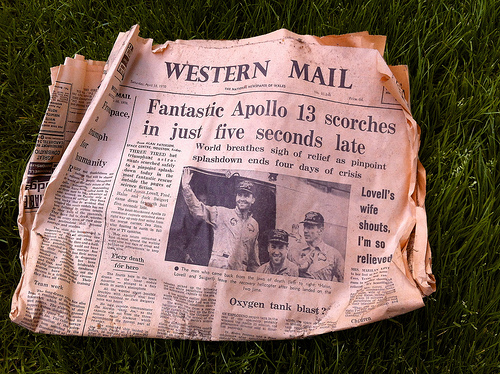
On April 14, 1970, the lives of three American astronauts hung in the balance when an explosion took place aboard their spacecraft, 200,000 miles from Earth. As Jim Lovell, Fred Haise, and Jack Swigert scrambled to stop a massive oxygen leak, the team at Mission Control began to assess the damage and figure out a way to adapt to the new circumstances.

Ironically, despite the chaos swirling around, when you listen to the original recording of the moments just after the explosion, you hear calm voices. Even faced with dire and immediate peril, the astronauts and those supporting them are already directing their energy toward what has abruptly become their new mission: working together against the clock to develop a solution that will bring them back safely.

Most of us will never experience a crisis of that magnitude, one in which lives depend on our ability to make split-second judgments.  But we will face a moment of difficulty and challenge. It may be an unexpected shift in the environment, a quickly escalating organizational problem, even an inexplicable loss of personal confidence.

It’s not a question of if, but when. And that’s when adaptive energy becomes a critical resource.

Adaptive energy is what gives us the courage to persist in the face of failure, the resilience to bring our best effort at the worst of times, the strength to stay focused on our goals even through pangs of fear or clouds of uncertainty.

Cultivating adaptive energy means practicing the self-awareness to understand that we can never control all the circumstances around us or have the answer to every situation, listening to and assessing multiple sources, and learning to bring those sources together effectively to develop creative solutions.

The unexpected is already moving toward you. You can’t prevent it, but you can prepare for it—by beginning now to build your capacity for adaptive energy.


Gaining Altitude through Reflection

by Steven Snyder on September 19, 2013

3851732077_081d42d1a0Thousands of times a day, people board airplanes that carry them across the country and around the world. Navy pilots land on aircraft carriers, helicopters are used to help fight wildfires, and men and women are living and working aboard the International Space Station. One-hundred-and-ten years after their 12-second flight, Orville and Wilbur Wright are still making a difference, thanks to their practice of reflection and reinvention.

Although the Wrights were not the first to build an aircraft, they believed that the solution for a safe, manned flight was not to use a more powerful engine, but to find a way for the pilot to control the craft. Studying past failures – both theirs and those of earlier aviators – they reflected on what they could do differently, and started testing their theories using large kites.

Through their kite flying and wind tunnel tests, they discovered three-axis control, which remains the standard in fixed-wing aviation to this day. Before they made history in Kill Devil Hills, the Wright brothers experienced multiple challenges; but instead of giving up, they grew through them and continued to work towards their dream of controlled flight.

Even after their success in December of 1903, they maintained their growth mind-set, reflecting on what worked and what they could do differently. In this, we could all do to emulate Orville and Wilbur: they didn’t stop growing because they had achieved one goal – they simply aimed higher.

How often do you sit down and reflect on what’s going on in your life or business? Once a year, like a New Years resolution list? Once a month, while you’re balancing your budget? Would you be surprised if I said you should do it once a week? 

How will you know what’s working, or what’s not, if you never take the time to reflect on the events of the past? If I have a positive experience, either personal or work-related, I want to know how my efforts contributed to the outcome so I can replicate them in the future. I want to learn from my successes, and my failures, so I can move forward with confidence.

Making time for reflection is part of embracing the art of struggle. While there will always be difficulties and set-backs, we can choose to learn from both the missteps and the wins. In order to thrive in the midst of struggle, it’s important that you take the time to develop a forward thinking, growth oriented mind-set.

In other words, don’t simply focus on what’s not working – learn to reflect on what is; see the opportunities, not just the obstacles.

While the Wright brothers experienced plenty of failures during their early years, they also recognized that each failure and success got them a step closer to their goal. As another famous pioneer (Thomas A. Edison) once said, “I have not failed. I’ve just found 10,000 ways that won’t work.

Embrace the art of struggle, and the sky’s the limit!


Turning Failure Into Success

September 12, 2013

A visionary who was unable to successfully manage finances, Walt Disney experienced bankruptcy before his 22nd birthday. After writing his first children’s book, And to Think That I Saw It on Mulberry Street, Theodor Seuss Geisel had 27 publishers reject his manuscript. Oprah Winfrey was fired from her reporting job because she “wasn’t fit” for […]

Read the full article →