Leadership

Microsoft’s Crucible Moment

by Steven Snyder on February 11, 2014

Satya Nadella, MicrosoftIn the 1980’s, when I worked for Microsoft, you could feel the buzz. We were only 250 employees back then, but each one brought enormous drive and energy. The company worked together as one—the whole greater than the sum of the parts.

Microsoft still has some of the most talented employees in the world, now numbering over 100,000. They’ve fallen behind because they’ve not been able to fully channel those capabilities to meet changing market needs.

The appointment of Satya Nadella, a Microsoft veteran of 22 years, has drawn much criticism.

Many argue that Microsoft should have recruited from the outside. But these critical voices do not fully understand the complexity and risks of bringing in outside leadership.

It is easy to point to the spectacular turnaround of IBM by outsider Lou Gerstner in the 1990’s. But, there have been some monumental failures as well, when outsiders have acted without fully understanding the facts on the ground. Just look at what Ron Johnson did to JC Penney or what Leo Apotheker did to HP.

Nadella knows Microsoft intimately, and can draw on its many strengths. In addition to a talented work force, they have a hugely profitable business, plenty of cash, and a large customer base.

This is not to minimize Nadella’s challenges. Technology is changing rapidly, and Microsoft has been out of touch in many ways. Product development cycles need to be drastically reduced. And energy draining fiefdoms must be eliminated and a culture revived.

Nearly forty years after its founding, Microsoft is at a crossroads. Will Nadella rise to the occasion?

I am optimistic that he will. Nadella is well respected internally, and many company employees favor a leader who has deep technical expertise. Furthermore, Bill Gates’s return as a technical adviser bodes well. I worked closely with Gates in the 1980’s, and his wise advice and sharp critical thinking skills helped me steer clear of many landmines.

Another reason to be optimistic is that Microsoft’s strategy is fundamentally sound. Moore’s law is driving down the cost of tablets, while increasing their processing power. Soon these tablets will be more powerful than the desktops of just a couple of years ago. Apple and Google’s strategy has been to power these devices with an operating system that has grown up from the smart phone. Over the years they’ve added more and more features, but this paradigm has its limits.

Microsoft’s strategy is to inject these tablets with a full-fledged operating system, capable of handling the most sophisticated applications that will soon be possible on the ever-more-powerful tablet devices. In short, Microsoft is well positioned to take advantage of the inevitable consequence of Moore’s law, just as it did in the 1990’s, when Windows rode the wave of microprocessors capable of powering a graphical user interface.

Microsoft has the right organizational strategy as well. The vision embodied in Steve Ballmer’s July 2013 “One Microsoft” memo was basically sound, even if Ballmer wasn’t the right person to implement it.

Clearly this is a crucible moment for Microsoft. Nadella needs to restore the buzz it had in the 1980’s. If he does that, Microsoft can be a great company again.
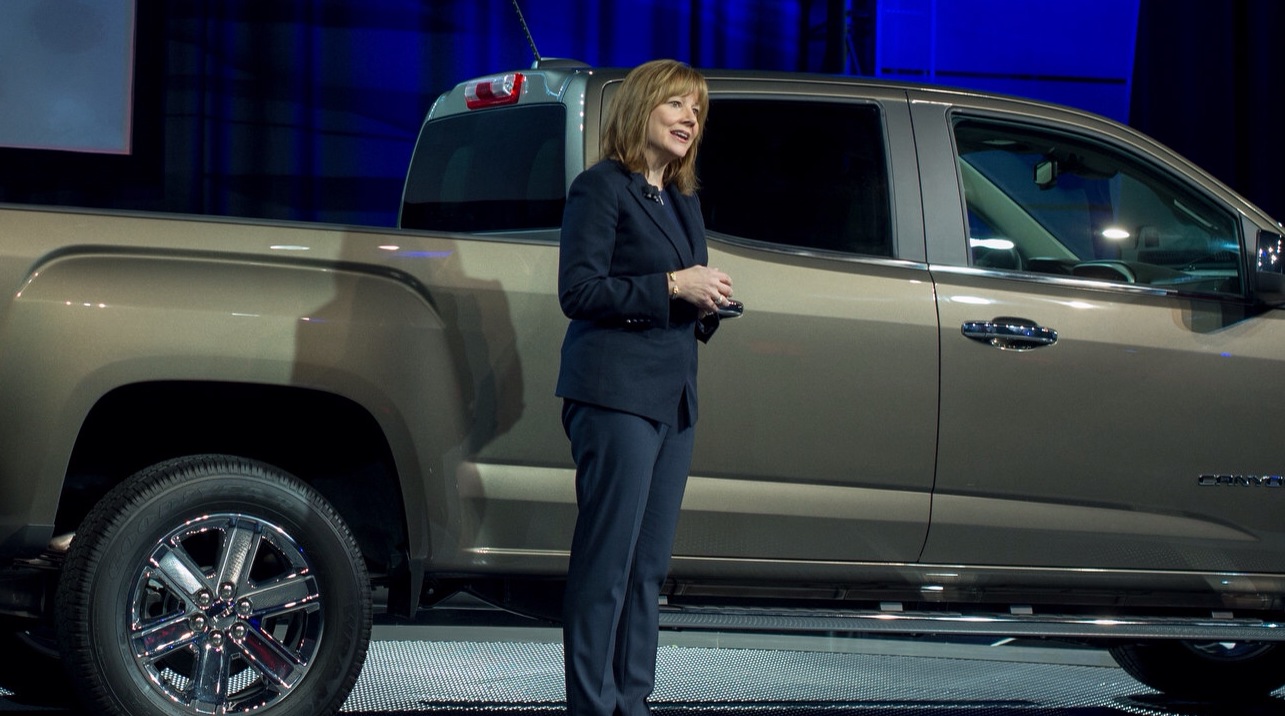

GMCCanyonReveal01.jpgI had the privilege of getting to know GM’s new CEO Mary Barra last summer, when we both attended Leading a Global Enterprise, an Executive Education Program at the Harvard Business School.

Barra embodies the very essence of a 21st century global leader, and she is a leader whom I have come to truly admire. Here are some of the lessons we can learn from her steady thirty-three year rise at one of the world’s largest corporations:

  1. Quiet leadership is a workable model for a senior executive. When we think of corporate CEOs, the prima donna image immediately comes to mind: flamboyant, lavish, egotistical, not a team player. Mary Barra is the complete opposite. She is humble and collaborative, eager to give credit to her team rather than steal the limelight herself. Being humble doesn’t necessarily mean lacking  in self-confidence. Barra exudes a sense of quiet confidence that makes you want to trust and admire her.
  2. Bring order into a chaotic world. One of a leader’s most important tasks is to impose order and rationality into the chaotic swirl that is today’s business environment. GM’s product development process was in disarray when Barra took over as product chief in 2011. There were 30 different platforms, and inefficiency and poor quality ran rampant. Barra immediately set to work, rationalizing the product line, improving quality and efficiency, and better aligning the product with customer needs. According to outgoing CEO Dan Akerson, Barra’s ability to bring order to the chaotic product development process was one of the major factors that led to her selection as GM’s next CEO.
  3. Build your own expanding hedgehog. In Good to Great, Jim Collins writes about the Hedgehog Model, the intersection of three essential factors for success: (1) what you are passionate about; (2) what you are really good at; and (3) what will reward you economically for your hard work. Barra’s career is the epitome of a perfectly executed expanding hedgehog play. She came to know her passion for cars at a very early age. Throughout her career she expanded the range of what she’s good at, starting with a foundation in engineering, and quickly acquiring skills in quality control, production, human resources, product development, and supply chain management. Lastly, Barra was able to realize the economic fruits of her labors. But she did this by keeping the company’s interests on center stage. By her own account, rather than thinking about the next step in her career ladder, she focused all of her efforts on being successful in her current job. By exceling in each of her many roles, she paved the way to make an ever-increasing economic contribution at GM. It was the economic value Barra created for her company that led to her own financial and career advancement.
  4. Never stop learning. Barra’s decision to take time away from her busy job, to attend the Harvard Business School program, is one indication of the importance Barra places on learning and development. In each of her previous roles she learned crucial new skills. Now in the top job, she must further expand her skill set, adding global finance, marketing, and sales to her portfolio.
  5. Treat people with dignity and respect. Barra comes across as a genuine, caring, and authentic human being. When she led Human Resources in 2009, just after the GM meltdown, she replaced the bureaucratic image of HR with a human face, emphasizing personal accountability and responsibility. It is truly amazing how empowering it can be when a leader treats a worker as a capable and well-intentioned human being, instead of a number on the assembly line.

photo by GM 

Face the Unexpected by Cultivating the Power of Adaptive Energy

October 10, 2013

“Houston, we’ve had a problem.” Jack Swigert, Astronaut, Apollo 13 On April 14, 1970, the lives of three American astronauts hung in the balance when an explosion took place aboard their spacecraft, 200,000 miles from Earth. As Jim Lovell, Fred Haise, and Jack Swigert scrambled to stop a massive oxygen leak, the team at Mission […]

Read the full article →

Becoming Proactive about Blind Spots

September 26, 2013

“He was right in my blind spot!” How many times has that been said after a car or a cyclist has suddenly pulled into view? Sometimes you hear the horn before you see the vehicle, or you glance in your mirror one more time and feel a sense of panic when you see a car […]

Read the full article →

Gaining Altitude through Reflection

September 19, 2013

Thousands of times a day, people board airplanes that carry them across the country and around the world. Navy pilots land on aircraft carriers, helicopters are used to help fight wildfires, and men and women are living and working aboard the International Space Station. One-hundred-and-ten years after their 12-second flight, Orville and Wilbur Wright are […]

Read the full article →

Turning Failure Into Success

September 12, 2013

A visionary who was unable to successfully manage finances, Walt Disney experienced bankruptcy before his 22nd birthday. After writing his first children’s book, And to Think That I Saw It on Mulberry Street, Theodor Seuss Geisel had 27 publishers reject his manuscript. Oprah Winfrey was fired from her reporting job because she “wasn’t fit” for […]

Read the full article →

Finding Balance

September 6, 2013

Finding a balance might be one of the most relatable aspects of leadership struggle, even for those who are not currently in a position to lead. In Leadership and the Art of Struggle, I primarily focused on the struggle to find balance in leadership, but most of us can identify with trying to find balance […]

Read the full article →

Struggle as Art

August 1, 2013

What do Michelangelo, da Vinci, Beethoven, and Steve Jobs have in common? At first glance, perhaps nothing. But what would you think if I said that they are all artists? Michelangelo is known for sculpting David, da Vinci for the secretive Mona Lisa, and Beethoven for his epic Ode to Joy. Steve Jobs? Contrary to […]

Read the full article →

Recognizing and Recovering From Blind Spots

July 11, 2013

As leaders, we simply don’t pay enough attention to blind spots. Experience blinds us to current struggles and difficulties. When we’re so wrapped up in past success, we begin to miss what’s going on in our lives today. If not looked for and anticipated, change – and its sub-elements, tension and balance – can become […]

Read the full article →