
perseverance

Big Dreams, Hard Work

by Steven Snyder on October 25, 2013

Big Dreams, Hard WorkOn a September day in 1913, a baby was born in Alabama who was destined for greatness, though no one would have dreamed it at the time. It wasn’t until the summer of 1936 when Jesse Owens, the son of a sharecropper, would make history at the Berlin Olympics.

Though we can create blueprints for how things should go, we have no way of knowing what the outcome of our efforts will be. We can organize and strategize, but it is physically impossible to plan for every eventuality, no matter how hard we try.  There is always the chance of a breakdown in the plans, but one thing is certain: to not try at all is to guarantee failure.

We might not try because of fear of the unknown, or because of the safety net that status quo provides. We might be embarrassed by failure, or afraid of what others might think, or we might do something as simple as listen to the naysayers. But if Jesse Owens had accepted status quo, he would never have found himself standing on the top podium four times in 1936.

Despite illness, racism, and poverty, Jesse Owens never took “no” for an answer, and I believe that’s due, in part, to his personal support team. Starting with his parents who expected him to work hard, then his junior high track coach who met him before school to help him practice.

Faced with bigotry and hatred, Owens continually responded with dedication and resolve, taking home a total of four gold medals, and cementing his place in Olympic, and American, history. Lesson learned: Dream big, and then do the work.

“We all have dreams. In order to make dreams come into reality, it takes an awful lot of determination, dedication, self-discipline and effort.”

Jesse Owens


Image credit: Duncan Rawlinson
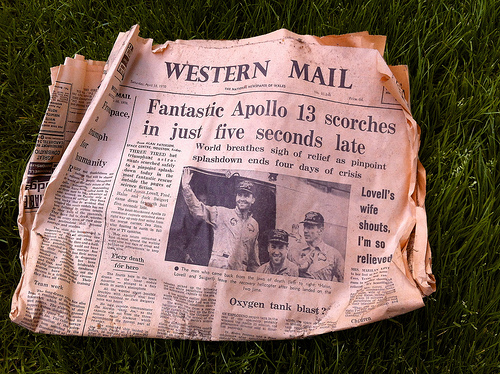
Power of Adaptive Energy“Houston, we’ve had a problem.”
Jack Swigert, Astronaut, Apollo 13

On April 14, 1970, the lives of three American astronauts hung in the balance when an explosion took place aboard their spacecraft, 200,000 miles from Earth. As Jim Lovell, Fred Haise, and Jack Swigert scrambled to stop a massive oxygen leak, the team at Mission Control began to assess the damage and figure out a way to adapt to the new circumstances.

Ironically, despite the chaos swirling around, when you listen to the original recording of the moments just after the explosion, you hear calm voices. Even faced with dire and immediate peril, the astronauts and those supporting them are already directing their energy toward what has abruptly become their new mission: working together against the clock to develop a solution that will bring them back safely.

Most of us will never experience a crisis of that magnitude, one in which lives depend on our ability to make split-second judgments.  But we will face a moment of difficulty and challenge. It may be an unexpected shift in the environment, a quickly escalating organizational problem, even an inexplicable loss of personal confidence.

It’s not a question of if, but when. And that’s when adaptive energy becomes a critical resource.

Adaptive energy is what gives us the courage to persist in the face of failure, the resilience to bring our best effort at the worst of times, the strength to stay focused on our goals even through pangs of fear or clouds of uncertainty.

Cultivating adaptive energy means practicing the self-awareness to understand that we can never control all the circumstances around us or have the answer to every situation, listening to and assessing multiple sources, and learning to bring those sources together effectively to develop creative solutions.

The unexpected is already moving toward you. You can’t prevent it, but you can prepare for it—by beginning now to build your capacity for adaptive energy.

Gaining Altitude through Reflection

September 19, 2013

Thousands of times a day, people board airplanes that carry them across the country and around the world. Navy pilots land on aircraft carriers, helicopters are used to help fight wildfires, and men and women are living and working aboard the International Space Station. One-hundred-and-ten years after their 12-second flight, Orville and Wilbur Wright are […]

Read the full article →

Turning Failure Into Success

September 12, 2013

A visionary who was unable to successfully manage finances, Walt Disney experienced bankruptcy before his 22nd birthday. After writing his first children’s book, And to Think That I Saw It on Mulberry Street, Theodor Seuss Geisel had 27 publishers reject his manuscript. Oprah Winfrey was fired from her reporting job because she “wasn’t fit” for […]

Read the full article →